
C03 - Adaptive manufacturing of auxiliary joining components as a basis for versatile joining processes with auxiliary joining components
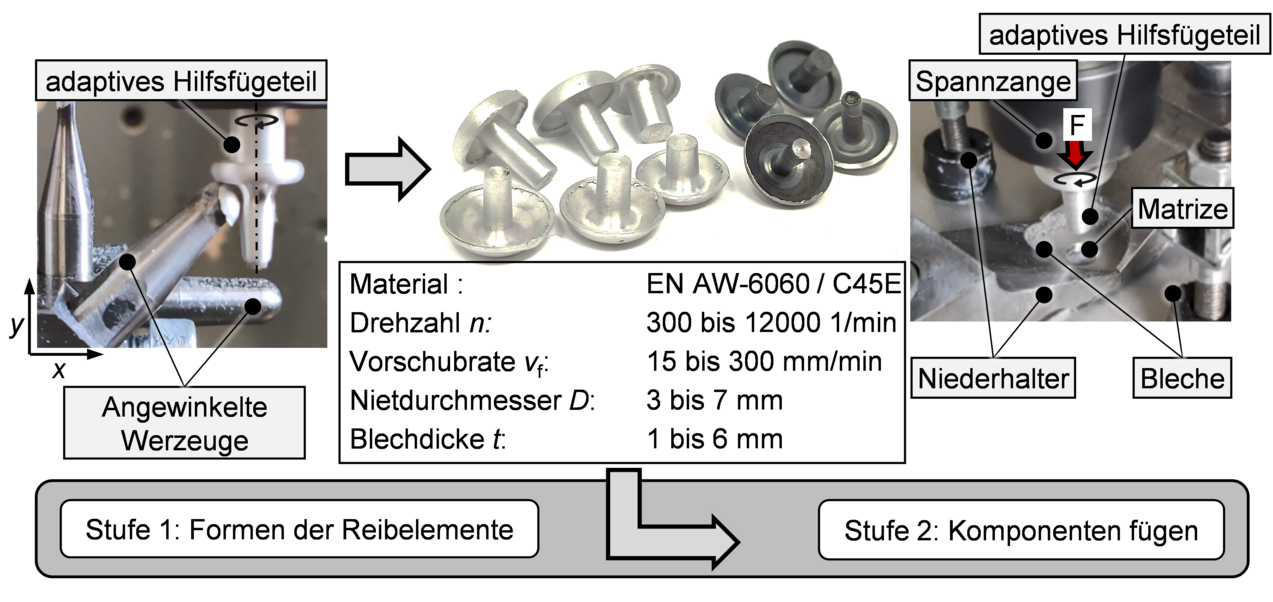
The proposed research project on form-fit and force-fit joining with adapted auxiliary joining components aims to investigate a new approach to the forming-based joining of materials using auxiliary joining components. The central research idea of this subproject is the individual inline adaptation or execution of the auxiliary joining parts in the process in combination with a correspondingly adapted process control during joining, so that the process can be individually adapted to each joining point. The general process sequence is initially divided into three sub-steps: 1. thermo-mechanically form the individually adapted auxiliary joining part. 2. Joining with the auxiliary joining part and finally 3. Separating the auxiliary joining part. The auxiliary joining part is manufactured and adapted in the joining tool from semi-finished products, such as wire sections or tubes, using a new process similar to pressing, and remains on the starting material until separation. This enables the individualization of each individual joint. The special thermo-mechanical process control enables the created auxiliary joining part to be optimally adapted to the locally required joining conditions, including heat treatment by the process-induced frictional heat. The aim is to open up the widest possible range of joining connections and joining partners with a single joining device. As part of subproject C03, a holistic approach (analysis, simulation, etc.) is to be used to develop a new process for the production of friction-stir welded joints. The special thermo-mechanical process control enables the created auxiliary joining part to be optimally adapted to the locally required joining conditions, including heat treatment by the process-induced frictional heat. The aim is to open up the widest possible range of joints and joining partners with a single joining device. As part of subproject C03, a holistic approach (analysis, simulation, design, integration into corresponding manufacturing process chains, and quality assurance) will be used to investigate fundamental research into process strategies for form-fit and force-fit joining with adapted auxiliary joining parts. The aim is to create a versatile and robust overall joining process that can be used for a wide range of material combinations and thicknesses, such as metal/metal to metal/FRP joints, with minimal setup effort or redesign of existing process chains, and can be adapted to specific requirements.



Publications
Joining with Versatile Friction-Spun Joint Connectors
T. Rostek, E. Wiens, W. Homberg, Procedia Manufacturing 47 (2020) 395–399.
Joining with Friction Spun Joint Connectors – Manufacturing and Analysis
C. Wischer, C. Steinfelder, W. Homberg, A. Brosius, IOP Conference Series: Materials Science and Engineering 1157 (2021) 012007.
A contribution on versatile process chains: joining with adaptive joining elements, formed by friction spinning
C. Wischer, W. Homberg, Production Engineering (2021).
Development of a novel adaptive joining technology employing friction-spun joint connectors (FSJC)
E. Wiens, C. Wischer, W. Homberg, ESAFORM (2021) 4682.
Joining with versatile joining elements formed by friction spinning
C. Wischer, E. Wiens, W. Homberg, Journal of Advanced Joining Processes 3 (2021).
Review on mechanical joining by plastic deformation
G. Meschut, M. Merklein, A. Brosius, D. Drummer, L. Fratini, U. Füssel, M. Gude, W. Homberg, P.A.F. Martins, M. Bobbert, M. Lechner, R. Kupfer, B. Gröger, D. Han, J. Kalich, F. Kappe, T. Kleffel, D. Köhler, C.-M. Kuball, J. Popp, D. Römisch, J. Troschitz, C. Wischer, S. Wituschek, M. Wolf, Journal of Advanced Joining Processes 5 (2022).
Identification of Requirements for FE Modeling of an Adaptive Joining Technology Employing Friction-Spun Joint Connectors (FSJC)
A. Oesterwinter, C. Wischer, W. Homberg, Metals 12 (2022).
Further Development of an Adaptive Joining Technique Based on Friction Spinning to Produce Pre-Hole-Free Joints
C. Wischer, W. Homberg, Key Engineering Materials 926 (2022) 1468–1478.
Investigations on the Influences of the Thermomechanical Manufacturing of Aluminium Auxiliary Joining Elements
T. Borgert, M. Henke, W. Homberg, Journal of Manufacturing and Materials Processing 7 (2023).
Friction-Induced Recycled Aluminium Semi-finished Products in Thermo-mechanical Joining Technology
T. Borgert, W. Homberg, in: Lecture Notes in Mechanical Engineering, Springer Nature Switzerland, Cham, 2023.
Thermomechanical Joining of Hypoeutectic Aluminium Cast Plates
T. Borgert, M. Neuser, K.-P. Hoyer, W. Homberg, M. Schaper, Journal of Manufacturing and Materials Processing 7 (2023).
Influence of thermo-mechanical joining process on the microstructure of a hypoeutectic aluminium cast alloy
T. Borgert, M. Neuser, E. Wiens, O. Grydin, W. Homberg, M. Schaper, in: Materials Research Proceedings, Materials Research Forum LLC, 2023, pp. 187–194.
In-situ computed tomography analysis of the failure mechanisms of thermomechanically manufactured joints with auxiliary joining element
T. Borgert, D. Köhler, E. Wiens, R. Kupfer, J. Troschitz, W. Homberg, M. Gude, Proceedings of the Institution of Mechanical Engineers, Part L: Journal of Materials: Design and Applications 238 (2024) 2299–2306.
Form-based manufacturing of aluminium and steel auxiliary joining elements as the basis for an efficient joining operation
T. Borgert, A.B. Nordieker, W. Homberg, in: Materials Research Proceedings, Materials Research Forum LLC, 2024.
Investigations to improve the tool life during thermomechanical and incremental forming of steel auxiliary joining elements
T. Borgert, A.B. Nordieker, E. Wiens, W. Homberg, Journal of Advanced Joining Processes 9 (2024).
Non-destructive testing in versatile joining processes
M. Lechner, T. Borgert, M. Busch, A. Harms, P.K. Holtkamp, D. Römisch, S. Wituschek, F. Kappe, in: Materials Research Proceedings, Materials Research Forum LLC, 2025.
Quenching During Thermomechanical Joining Using Friction Spun Joint Connectors
A.B. Nordieker, W. Homberg, Transactions of the Indian Institute of Metals 79 (2026).
Show all publications